The Complete Guide to Paraphrasing
Comprehensive guide from Purdue University's Online Writing Lab with current examples and exercises for proper paraphrasing techniques.
 Store4AI
Powerful free tools to rewrite, enhance, and improve your writing without plagiarism
AI-powered paraphrasing with multiple modes and grammar checking.
Quick paraphrasing with grammar checking and multiple modes.
Academic paraphrasing tool with plagiarism checking.
Simple tool for quick content rewrites.
Basic text spinner for simple rewrites.
Supports multiple languages with plagiarism checking.
Quick online paraphrasing with word limit.
Free online paraphrasing with multiple modes.
Simple paraphrasing with synonym replacement.
AI-based rephrasing tool for content rewriting.
Grammar, spelling, and basic rewriting suggestions.
Improves readability with simpler phrasing.
AI-powered sentence rewrites with tone options.
Grammar and style improvements with AI.
Comprehensive writing reports with style suggestions.
Grammar checker with paraphrasing suggestions.
Can paraphrase and rewrite text (requires account).
AI writing assistant with free paraphrasing (limited).
AI-based rewriting tool for content creation.
AI writing assistant with paraphrasing (limited words).
Why are paraphrasing tools indispensable in modern writing? Here are the key benefits:
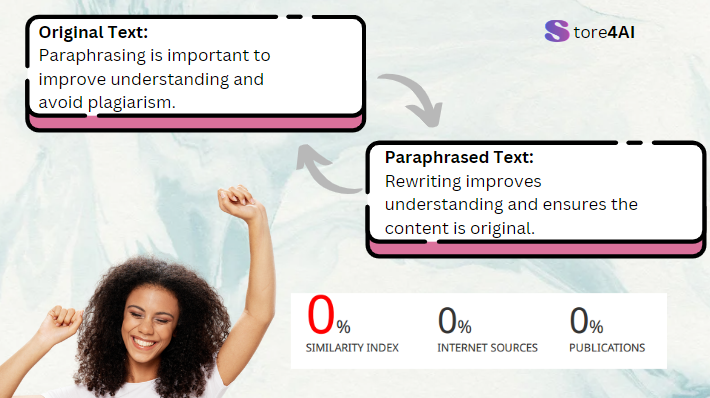
A guide to properly rewording source material while maintaining meaning
Paraphrasing is the process of rewording someone else's text or your text while maintaining the original meaning. It's not just about changing words with synonyms—it involves completely restructuring sentences and expressing ideas in your own unique way.
Paraphrasing involves putting a passage from source material into your own words. Unlike direct quotes, paraphrases are typically shorter than the original passage and demonstrate your understanding of the source material.
Key characteristics of effective paraphrasing:
Paraphrasing serves several important functions in academic writing:
By rewording source material, you show your comprehension of the ideas rather than just repeating them verbatim.
Paraphrasing allows you to incorporate source material while keeping your own writing style consistent.
Academic writing should primarily present your analysis, not string together numerous quotes.
You can emphasize certain aspects of the source material that are most relevant to your argument.
"The rise in antibiotic resistance is one of the world's most pressing health problems. Overuse of antibiotics in both humans and animals has accelerated this crisis, making once-treatable infections potentially deadly again." (World Health Organization, 2021)
According to the World Health Organization (2021), the increasing inability of antibiotics to combat infections, caused largely by excessive use in medical and agricultural contexts, has become a critical global health issue that is reviving the danger of previously manageable diseases.
The increase in antibiotic resistance is among the planet's most urgent health concerns. Excessive use of antibiotics in people and livestock has sped up this problem, causing formerly curable infections to become life-threatening once more (World Health Organization, 2021).
Making only superficial changes to the source text (synonym swapping or minor reordering) without truly transforming the language and structure.
Changing the original meaning, either accidentally or intentionally, through improper paraphrasing.
Failing to credit paraphrased material, which constitutes plagiarism even if the words are changed.
Stringing together multiple paraphrases without adequate original analysis or synthesis.
| Paraphrasing | Summarizing | |
|---|---|---|
| Length | Similar or slightly shorter than original | Significantly shorter than original |
| Detail | Includes specific details | Captures only main ideas |
| Purpose | Restate a particular passage | Provide overview of entire work |
Choose to paraphrase when:
Choose to quote when:
Master the art of rewriting content while preserving meaning
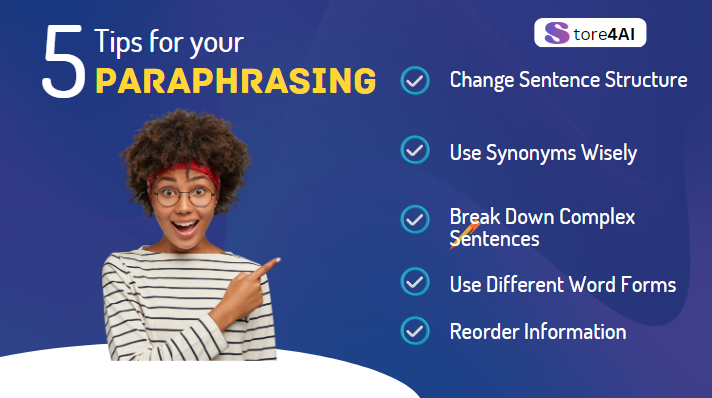
The paraphrasing process: Understand → Analyze → Rewrite → Compare
"The internet has revolutionized the way people access information and communicate with each other."
"Despite numerous studies confirming the benefits of exercise, many adults lead sedentary lifestyles."
"Global warming is causing polar ice caps to melt at an unprecedented rate, which threatens coastal communities worldwide."
"Effective communication skills are essential for career success because they enable professionals to convey ideas clearly and build strong relationships with colleagues."
"The invention of smartphones has dramatically changed daily life by providing instant access to information, communication tools, and entertainment options."
"Many educators believe that hands-on learning experiences are more effective than traditional lecture-based instruction for developing practical skills."
"The rapid growth of e-commerce has forced traditional retailers to adapt their business models or risk losing customers to online competitors."
"A balanced diet consisting of fruits, vegetables, whole grains, and lean proteins is fundamental to maintaining good health and preventing chronic diseases."
Learn professional techniques, avoid plagiarism, and improve your writing skills with these up-to-date resources

Comprehensive guide from Purdue University's Online Writing Lab with current examples and exercises for proper paraphrasing techniques.

Learn the difference between effective paraphrasing and plagiarism with clear examples from UofT's Writing Advice.

Official guide to transforming source material with academic integrity at UNSW.

Newcastle's step-by-step guide to rewriting sources correctly, with before/after examples and plagiarism avoidance tips.

Harvard's expert guides to writing conventions in sciences, humanities, and social sciences, including discipline-appropriate paraphrasing techniques.