Store4AI Logo Store4AI
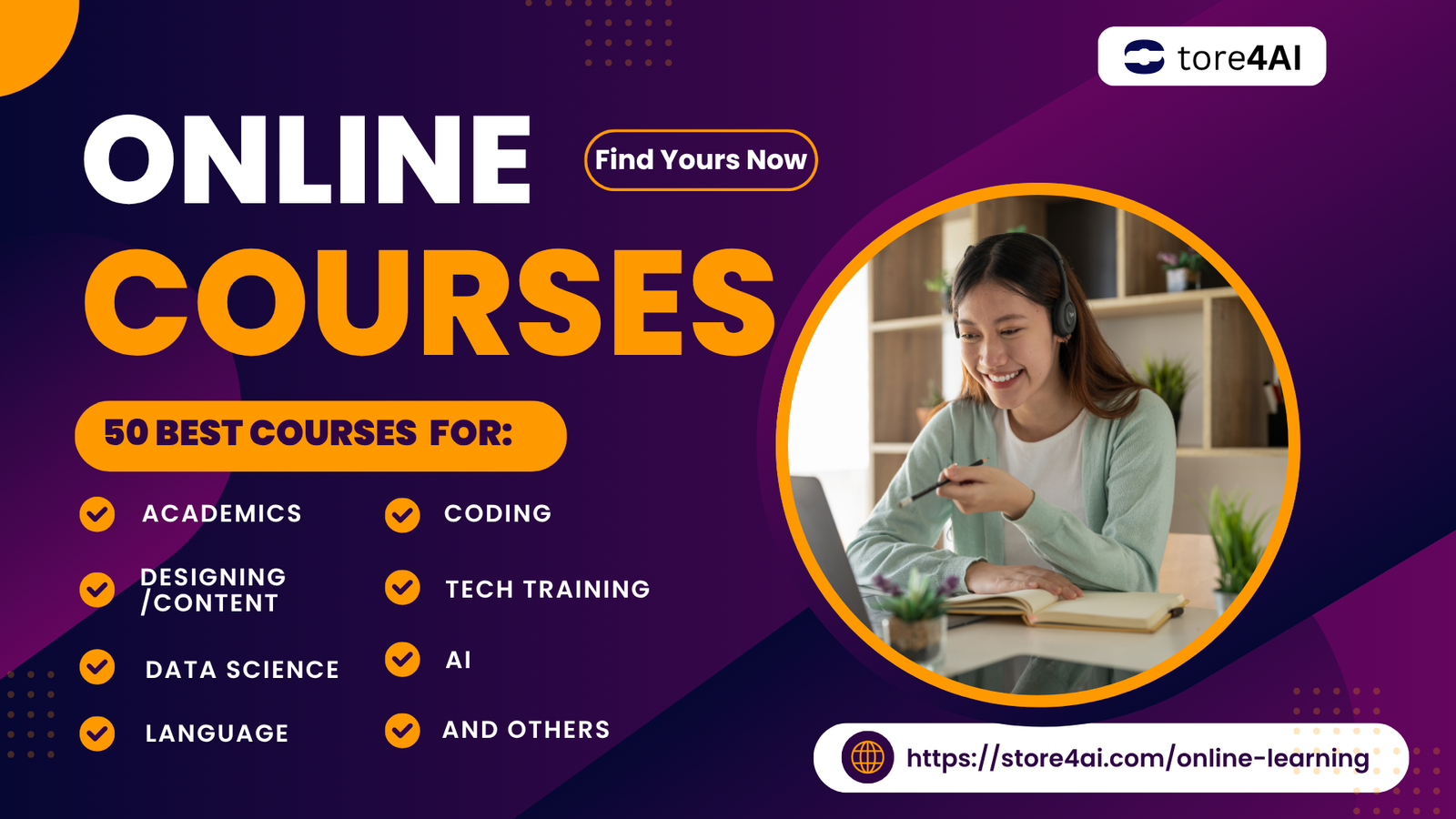
Store4AI Online Courses

Why choose Online Learning Courses?

In recent years, online learning platforms have revolutionized education by providing a more flexible and accessible approach to learning. Here are some key reasons why you should consider using online learning platforms:

Convenience
Variety of Courses
Cost-Effective
Personalized Learning
Access to Expert Instructors

Top 50 Online Learning Platforms

1. Udemy

A marketplace with thousands of affordable courses in various fields.

Visit Udemy

2. Coursera

Offers courses and degrees from top universities online.

Visit Coursera

3. Skillshare

Creative courses for design, photography, and more.

Visit Skillshare

4. Khan Academy

Free resources in math, science, and other subjects for students and teachers.

Visit Khan Academy

5. Codecademy

Learn coding interactively with hands-on projects.

Visit Codecademy

6. edX

Access free or paid university-level courses on various subjects.

Visit edX

7. LinkedIn Learning

Professional courses to boost your skills and career.

Visit LinkedIn Learning

8. Duolingo

Learn new languages in a gamified and fun way.

Visit Duolingo

9. FutureLearn

Short online courses to upskill quickly.

Visit FutureLearn

10. Memrise

Language learning with smart memory techniques.

Visit Memrise

11. Brilliant

Interactive learning in math, science, and computer science.

Visit Brilliant

12. Tynker

Learn programming skills for kids and beginners.

Visit Tynker

13. Babbel

Professional language lessons for travelers and learners.

Visit Babbel

14. OpenLearn

Free courses offered by The Open University.

Visit OpenLearn

15. Treehouse

Learn web design, coding, and app development.

Visit Treehouse

16. Quizlet

Create and study flashcards for any topic.

Visit Quizlet

17. Pluralsight

Tech training for software developers and IT professionals.

Visit Pluralsight

18. MIT OpenCourseWare

Free MIT courses on a variety of topics.

Visit MIT OpenCourseWare

19. Study.com

Online courses, practice tests, and college prep.

Visit Study.com

20. Prodigy

Math learning for children through games.

Visit Prodigy

21. Google Digital Garage

Free digital marketing courses and certifications.

Visit Google Digital Garage

22. YouTube Learning

Learn everything on YouTube with educational channels.

Visit YouTube Learning

23. Harvard Online Learning

Free and paid courses from Harvard University.

Visit Harvard Online Learning

24. Lynda

Creative and technical courses for all skill levels.

Visit Lynda

25. Udacity

Focused on tech, data science, AI, and programming courses.

Visit Udacity

26. Codewars

Improve your programming skills by solving challenges.

Visit Codewars

27. Khan Academy Kids

Free interactive learning for children under 7 years old.

Visit Khan Academy Kids

28. Seesaw

A platform for teachers to manage assignments and students' progress.

Visit Seesaw

29. Classcraft

Gamify your classroom to increase engagement.

Visit Classcraft

30. GoConqr

Create mind maps, flashcards, and quizzes for studying.

Visit GoConqr

31. Pluralsight

Tech training for software developers and IT professionals.

Visit Pluralsight

32. Khan Academy Kids

Free interactive learning for children under 7 years old.

Visit Khan Academy Kids

33. Skillshare

Creative courses for design, photography, and more.

Visit Skillshare

34. OpenAI

Learn more about AI development and GPT models.

Visit OpenAI

35. Duolingo

Learn new languages in a gamified and fun way.

Visit Duolingo

36. FutureLearn

Short online courses to upskill quickly.

Visit FutureLearn

37. Memrise

Language learning with smart memory techniques.

Visit Memrise

38. Treehouse

Learn web design, coding, and app development.

Visit Treehouse

39. Codewars

Improve your programming skills by solving challenges.

Visit Codewars

40. OpenLearn

Free courses offered by The Open University.

Visit OpenLearn

41. Lynda

Creative and technical courses for all skill levels.

Visit Lynda

42. Udacity

Focused on tech, data science, AI, and programming courses.

Visit Udacity

43. Google Digital Garage

Free digital marketing courses and certifications.

Visit Google Digital Garage

44. Study.com

Online courses, practice tests, and college prep.

Visit Study.com

45. Classcraft

Gamify your classroom to increase engagement.

Visit Classcraft

46. Quizlet

Create and study flashcards for any topic.

Visit Quizlet

47. Duolingo for Schools

Track students' progress while they learn languages.

Visit Duolingo for Schools

48. WizIQ

Virtual classroom platform for online courses and webinars.

Visit WizIQ

49. Edmodo

Classroom communication and learning management tool for teachers and students.

Visit Edmodo

50. Seesaw

A platform for teachers to manage assignments and students' progress.

Visit Seesaw

Expert Insights on Digital Education

The Evolution of Online Learning: From Correspondence Courses to AI Tutors

Online education has undergone a remarkable transformation since its inception. What began as simple correspondence courses in the 19th century has evolved into sophisticated digital learning ecosystems:

  • The 1990s: Basic text-based courses delivered via email
  • Early 2000s: Learning Management Systems (LMS) like Blackboard
  • 2010s: MOOCs (Massive Open Online Courses) revolution
  • 2020s: AI-powered adaptive learning platforms

Modern platforms like Coursera and Udacity now use machine learning algorithms to create personalized learning paths that adapt to each student's pace and comprehension level. The global e-learning market is projected to reach $848 billion by 2030, growing at 17.5% CAGR.

7 Science-Backed Strategies for Online Learning Success

Research from Harvard's Online Learning Initiative reveals key strategies for effective digital education:

  • The 50/10 Rule: Study for 50 minutes, break for 10
  • Active Recall: Test yourself every 20 minutes
  • Spaced Repetition: Review material at increasing intervals
  • Dual Coding: Combine verbal and visual information
  • Interleaving: Mix different subjects/types of problems
  • Elaboration: Explain concepts in your own words
  • Metacognition: Regularly self-assess your understanding

Platforms like Khan Academy and Brilliant incorporate these principles through their interactive exercises and progress tracking systems.

Do Online Certificates Hold Real Value? Industry Insights

A 2024 LinkedIn survey of 5,000 hiring managers reveals:

  • 82% consider MOOC certificates valid credentials
  • Top-valued platforms: Coursera (91%), edX (89%), Udacity (87%)
  • Most in-demand fields: Data Science (78%), Cloud Computing (72%), AI (68%)

Google's Career Certificates program reports that 75% of graduates find related employment within 6 months, with average salary increases of $30,000. Industry-recognized credentials from platforms like AWS Educate and Microsoft Learn show the highest ROI.

How Fortune 500 Companies Are Revolutionizing Employee Training

Corporate learning has shifted dramatically with platforms like:

  • LinkedIn Learning (used by 92% of Fortune 100 companies)
  • Pluralsight (tech skills development)
  • Degreed (learning experience platform)

Key trends include:

  • Microlearning: 3-7 minute focused lessons
  • Learning in the Flow of Work: Just-in-time training
  • Skills Mapping: AI-driven career pathing
  • VR Training: Walmart trains 1M+ employees annually in VR

Companies using these platforms report 34% higher employee retention and 24% greater productivity.

Beyond 2025: The Next Frontier in Educational Technology

Emerging technologies poised to transform online learning:

  • AI Tutors: Platforms like Duolingo Max using GPT-4 for personalized coaching
  • Neuroadaptive Learning: Systems adjusting content based on brain activity (EEG sensors)
  • Blockchain Credentials: Tamper-proof digital diplomas on distributed ledgers
  • Haptic Learning: Tactile feedback systems for hands-on skills training
  • Metaverse Campuses: Universities like Stanford developing VR learning environments

According to HolonIQ, global EdTech investment will reach $404B by 2027, with AI-driven platforms capturing 45% of market share. Early innovators include Coursera's AI course assistant and Codecademy's real-time code analysis.